
Home
Technical Blog
Publications
CV
Music
GitHub
About:
I am Jackson Vanover. I received my Ph.D. in Computer Science from UC Davis where I researched practical tools for testing and tuning numerical code.
Contact:
jacksonvanover [at] gmail [dot] com
Short Update: Actually Understanding NVIDIA's ESC Calculation
Last Updated: January 12, 2026DISCUSSED: misleading toy examples, hindsight being 20/20, lessons for the future
About a month ago, I wrote a short blog post describing my attempt to manually apply NVIDIA’s ESC algorithm to a simple example I contrived. This was in an attempt to better understand how NVIDIA is deploying “Ozaki-style emulation” in the latest versions of cuBLAS. There was a problem though: while the methodology described in the whitepaper is described as assuring at least double-precision accuracy for DGEMM, my calculations on the simple example yielded what appeared to be intolerable amounts of error.
Since then, I got in contact with someone from NVIDIA who helpfully cleared up my confusion that stemmed from a simple misunderstanding. The corrected results show that ESC clearly maintains safety with respect to the quality of the answer. At the same time, they also highlight the performance left on the table due to the potentially huge overhead of maintaining safety in this way.
The below assumes that the reader has made a pass over the original blog post. Check that out first for context and see if you can spot the blunder!
Where I went wrong in my understanding
Check out this phrase I typed in my initial post:
The goal of the ESC calculation is to estimate the number of extra bits needed to achieve FP64 accuracy for the dot product
Extra. EXTRA. The 13 required bits that I calculated for my simple example are extra bits on top of the original representation’s 53 mantissa bits.
It is so clear in hindsight: if the goal is to maintain double-precision accuracy, one cannot lose any of the information in the original mantissa bits. This is the type of thing that, once understood, reads as painfully obvious (though implied) when going over the whitepaper again. I found the phrasing unclear (obviously). An equation would have been super helpful for me, say…
…but, as it is, this info is sort of scattered about the section.
What should have happened in the example I proposed
For reference, here’s the Hadamard product from my example:
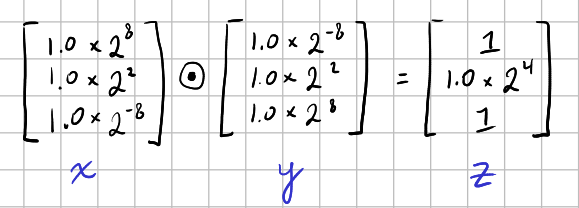
Based on my misunderstanding, I used only the ESC of 12 and the 1 carry bit, thereby miscalculating that cuBLAS would use two INT8 slices per element in the Hadamard product operands, truncating the \(1.0\times2^{-8}\) elements to zero like so:

I then showed that one needs a minimum of three INT8 slices to calculate a full fidelity output, which looks like this:

Based on the correct formula above, what cuBLAS would actually do is use nine INT8 slices. Given that the mantissa for each of the values can be represented with a single bit, this is massive overkill. Most of the INT8 slices are all zeros! Still, this is a toy example. In any realistic case, all those mantissa bits would need to be represented.
Note to future self
Toy examples are an essential tool for building intuitive understanding. But, if in working through a toy example one encounters unintuitive results, a more realistic example can shed some light. I am sure that I would have clarified my own earlier misunderstanding if I had started working through an example with more than 1 mantissa bit.